
A 405nm laser can support precision optical applications, but selecting the right module requires more than matching the wavelength. You also need to evaluate optical output, fiber compatibility, electrical requirements, thermal management, and integration space. If you are developing medical equipment, optical instruments, or specialized photonic systems, these factors directly affect how the laser fits your design.
The 105μm 405nm 300mW Violet Fiber Coupled Laser Module from Dongguan Blueuniverse Laser Co., Ltd. (BU-LASER) combines violet laser output with fiber-coupled transmission in a compact housing. With an operating voltage of 12V and continuous-wave (CW) operation, this module gives OEM engineers a defined starting point for evaluating optical integration. Before selecting it for your application, you should also verify the fiber interface, power requirements, and application-specific safety requirements.
405nm Laser Module: Key Specifications
The 405nm laser module uses violet laser light and a fiber-coupled optical design. Its published specifications help you assess whether it matches your equipment requirements.
| Parameter | Specification |
|---|---|
| Wavelength | 405nm violet |
| Optical output power | Greater than 300mW |
| Working mode | Continuous wave (CW) |
| Working voltage | 12V |
| Fiber core diameter | 105μm |
| Housing dimensions | 40 × 40 × 101mm |
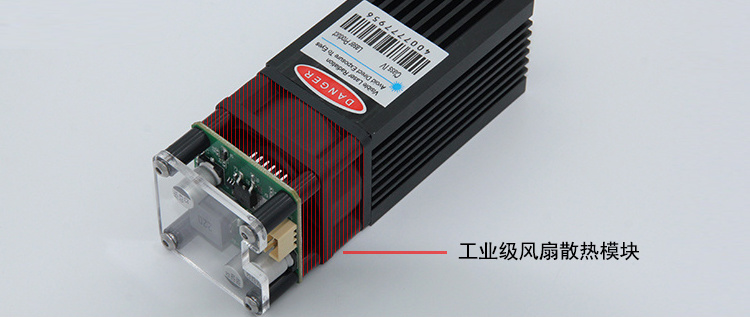
| Configuration | PCBA and air cooler |
| Optical lens | Glass |
| Stated lifespan | 10,000 hours |
| Model number | LY4035AC9A-105-A |
These specifications provide a useful basis for initial system selection. However, you should confirm the optical power measurement conditions, fiber numerical aperture, connector type, and operating temperature range with BU-LASER before finalizing your design.
Why Choose a 405nm Fiber-Coupled Laser?
1. Violet Wavelength for Specialized Optical Systems
A 405nm laser operates in the violet region of the visible spectrum. This wavelength can serve applications that require short-wavelength optical excitation or controlled violet illumination, depending on the optical system and target material.
Potential application areas include:
- Medical and aesthetic equipment: Evaluate the module as an optical component in equipment designed for specific light-based procedures.
- Photodynamic research: Assess wavelength compatibility with the selected photosensitizer and the complete optical delivery system.
- Optical inspection: Integrate violet illumination where the target material and detection method benefit from 405nm light.
- Specialized instruments: Use the wavelength as a design parameter when developing customized optical equipment.
Actual suitability depends on the target material, optical power density, exposure duration, and system configuration. A 405nm wavelength alone does not establish clinical effectiveness or medical-device approval.
2. Fiber-Coupled Output for Flexible Integration
The 105μm fiber core supports optical delivery through a fiber-based system, allowing engineers to separate the laser module from the final optical delivery point.
For example, an equipment designer can evaluate a fiber-coupled architecture when the laser source and treatment or inspection head need different mounting positions. The final arrangement depends on fiber length, connector compatibility, bending limits, and the required output at the working surface.
Before purchasing, confirm whether the supplied configuration includes the optical fiber and connector or requires a separately specified fiber assembly.
3. 300mW Output and 12V Operation
With an optical output above 300mW and a 12V working voltage, this module provides defined power and electrical parameters for preliminary system design.
The included PCBA and air cooler also give you specific hardware details to consider when planning the power supply, airflow, mounting arrangement, and enclosure. You should still verify current consumption, allowable voltage variation, heat dissipation requirements, and output stability under your intended operating conditions.
Fiber-Coupled Laser Module vs. Standalone Laser Diode
Choosing between an integrated module and a standalone diode depends on your development resources and equipment architecture.
| Selection factor | Fiber-coupled laser module | Standalone laser diode |
|---|---|---|
| Optical delivery | Designed for fiber-coupled output | Depends on the external optical assembly |
| Integration work | Evaluate the supplied module configuration | May require additional optical and mechanical integration |
| Electrical design | Confirm module input requirements | Design around the diode’s specified drive conditions |
| Thermal management | Assess the included cooling arrangement | Design cooling for the selected diode and operating conditions |
| Best evaluation criterion | Compatibility with the complete equipment | Flexibility of the custom optical design |
Neither configuration is universally better. If your project needs a defined fiber-coupled arrangement, start by checking the complete module’s interfaces and performance specifications.
How to Select a 405nm Laser for Your Project
Follow these steps before placing an OEM or ODM order.
- Define the application. Identify whether you need violet illumination, optical excitation, inspection, or integration into specialized medical equipment.
- Confirm the optical requirements. Specify the 405nm wavelength, required power at the working point, exposure conditions, and optical delivery method.
- Check fiber compatibility. Verify the 105μm core, numerical aperture, connector, fiber length, and allowable bending radius.
- Review electrical and thermal conditions. Confirm the 12V input, current requirements, cooling arrangement, and available installation space.
- Request technical documentation. Review the product datasheet and discuss operating limits, quality documentation, customization options, and sample evaluation with the manufacturer.
- Validate the integrated system. Test output stability, optical alignment, temperature, and applicable laser safety controls under representative operating conditions.
Why Work With BU-LASER?
Founded in 2010, Dongguan Blueuniverse Laser Co., Ltd. develops and manufactures semiconductor laser diodes, laser modules, and fiber-coupled laser products. Its product portfolio covers wavelengths from 375nm to 980nm, serving applications such as laser security, 3D scanning, optical inspection, medical aesthetics, and stage lighting.
BU-LASER provides OEM and ODM services for customers who need to evaluate customized laser solutions. The company reports holding more than 80 patents, including 14 invention patents, and maintaining an ISO 9001:2015 quality management system. It also lists TUV, BV, and SGS among its certification-related credentials; confirm the scope and validity of any specific certificate relevant to your procurement requirements.
For this 405nm laser module, request the model-specific datasheet and clarify whether your desired fiber assembly, power configuration, and mechanical dimensions are available.
FAQ
1. What is the output power of this 405nm laser module?
The published continuous-wave optical output is greater than 300mW. Confirm the guaranteed minimum output and measurement conditions with BU-LASER.
2. Can this 405nm laser module be used in medical equipment?
It can be evaluated as an optical component for a suitable equipment design. However, application suitability depends on the intended procedure, optical delivery system, risk assessment, and applicable regulatory requirements. The product specifications alone do not establish medical-device approval.
3. Does BU-LASER offer OEM and ODM customization?
Yes. BU-LASER states that it offers OEM and ODM services for its laser products. Contact the company to confirm customization options, minimum order requirements, sample availability, and delivery schedules for model LY4035AC9A-105-A.
Conclusion
The 405nm laser module LY4035AC9A-105-A combines violet 405nm output above 300mW, a 105μm fiber core, 12V operation, and a housing measuring 40 × 40 × 101mm. These parameters make it a candidate for evaluation in fiber-coupled optical systems, specialized instruments, and suitable medical-equipment designs. By verifying optical interfaces, thermal requirements, output performance, and application-specific compliance, you can determine whether this module meets your engineering and procurement needs.
Request Technical Details From BU-LASER
Planning a new optical system or evaluating a replacement laser source? Contact BU-LASER to request the product datasheet, confirm fiber and electrical compatibility, and discuss OEM/ODM requirements for your project.

Add comment