Birds gathering around farms, warehouses, food processing facilities, and industrial rooftops can create recurring maintenance and sanitation challenges. A laser bird repeller offers an alternative to conventional bird control methods by using moving laser light to discourage birds from settling in targeted areas. However, choosing the right system requires more than checking its wavelength or output power. You also need to consider coverage, installation conditions, weather resistance, operating schedules, and laser safety requirements. The BU-LASER 360-degree automatic rotating green laser light combines a 520nm wavelength, 1.6W output, and horizontal rotation for outdoor applications. Developed by Dongguan Blueuniverse Laser Co., Ltd., this product is worth evaluating when you need a configurable laser-based bird deterrent for large or exposed spaces.
How Does a 520nm Laser Bird Repeller Work?
A green laser bird deterrent uses visible light to create a moving visual stimulus that may discourage certain bird species from entering or remaining in an area. Its effectiveness depends on factors such as species, ambient lighting, beam movement, site layout, and previous exposure.
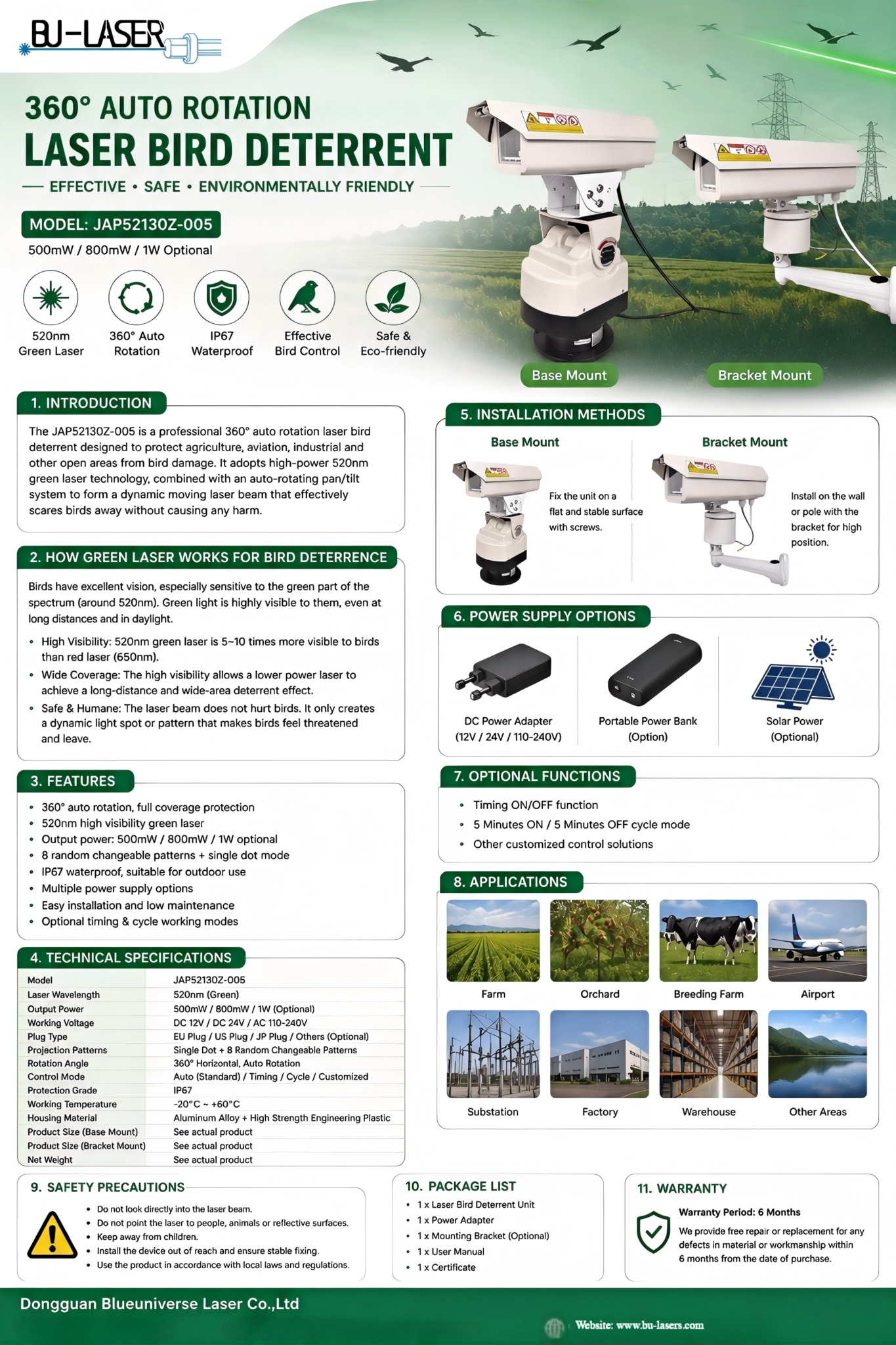
BU-LASER’s model uses a 520nm green laser with automatic 360-degree horizontal rotation. This configuration allows the beam to sweep across a broader area than a stationary beam, although actual coverage depends on mounting height, obstructions, and the installation environment.
Potential application sites include:
- Agriculture: Orchards and farmland where birds damage crops.
- Industrial facilities: Warehouse rooftops and outdoor storage areas.
- Food processing: Exterior zones where bird droppings create sanitation concerns.
- Utility infrastructure: Suitable perimeter areas around substations, subject to site-specific safety assessments.
Laser deterrence should form part of a broader bird management plan rather than serve as a guaranteed standalone solution.
Key Features of the BU-LASER Bird Repeller
1. 520nm Wavelength and 1.6W Output
The system operates at 520nm with a specified optical output of 1.6W. These parameters help buyers assess the product against their intended application and installation requirements.
Before purchasing a high-power green laser, verify its beam characteristics, operating conditions, and applicable laser classification. The listed output alone does not establish an appropriate safe operating distance.
2. Automatic 360° Horizontal Rotation
Continuous horizontal rotation helps distribute the moving beam across the surrounding area. The product also specifies an adjustable vertical pitching angle from -35° to +35°, providing flexibility when configuring the installation.
You can evaluate wall mounting, pole mounting, or floor fixing according to the site layout. Avoid directing the beam toward roads, aircraft operations, neighboring properties, or occupied areas.
3. Outdoor-Oriented Construction
The manufacturer specifies an IP65-rated enclosure and an operating temperature range of -25°C to +55°C. These specifications can help you assess suitability for exposed installations, but confirm the rating and environmental test documentation before deployment.
The housing measures 381 × 144 × 177 mm, with customized dimensions available according to the product listing.
4. Flexible Power and Control
The listed specifications include a working voltage of 110–260V, while the product description mentions an optional 12V DC configuration. Confirm the exact power supply included with your selected model.
The manufacturer also describes remote control for switching the unit on or off and adjusting rotation speed and operating modes.
Laser Bird Repeller vs. Conventional Bird Control
| Evaluation factor | BU-LASER rotating laser | Visual bird deterrents | Physical exclusion |
|---|---|---|---|
| Operating principle | Moving green laser light | Reflective or moving visual objects | Nets, barriers, or screens |
| Coverage approach | Rotating beam; site-dependent | Depends on placement | Covers protected structures |
| Power requirements | Electrical supply required | Often minimal | Depends on installation |
| Maintenance considerations | Check optics, rotation, and power | Inspect placement and condition | Inspect barriers and mounting |
| Best evaluation scenario | Open areas with suitable laser safety controls | Smaller areas or supplementary deterrence | Buildings and defined access points |
No single method works equally well for every bird species or site. Combining deterrents and monitoring results can help you develop a more reliable control strategy.
How to Select and Install a Laser Bird Repeller
Follow these steps before ordering your equipment:
- Assess the site: Identify bird species, activity periods, landing locations, and sensitive neighboring areas.
- Estimate coverage needs: Consider mounting height, obstacles, beam movement, and the required coverage pattern. Do not assume a stated frightening distance guarantees effective coverage.
- Confirm technical specifications: Verify the 520nm wavelength, 1.6W output, voltage, enclosure rating, control functions, and customized housing requirements.
- Review laser safety: Obtain the applicable laser classification and safety documentation. Arrange installation and access controls to prevent hazardous exposure to people, vehicles, and aircraft.
- Test and monitor performance: Record bird activity before and after deployment, then adjust the operating schedule or combine methods if results are insufficient.
Why Consider BU-LASER for OEM/ODM Projects?
Dongguan Blueuniverse Laser Co., Ltd. was founded in 2010 and develops semiconductor laser diodes, laser modules, and fiber-coupled lasers. Its stated product wavelength range is 375–980nm, supporting applications including security, sensing, scanning, engraving, and stage lighting.
BU-LASER reports more than 80 patents, including 14 invention patents, and identifies ISO 9001:2015, TUV, BV, and SGS among its quality or certification credentials. Buyers should request the relevant certificates and confirm which products and facilities they cover.
For OEM/ODM projects, discuss housing dimensions, electrical requirements, control functions, optical specifications, and intended deployment conditions with the manufacturer before finalizing your design.
FAQ
1. What is a 520nm laser bird repeller used for?
It uses moving green laser light to discourage birds from settling in selected outdoor areas, such as orchards, rooftops, and suitable industrial perimeters. Results depend on bird species and site conditions.
2. What is the output power of the BU-LASER model?
The listed output power is 1.6W at 520nm. Confirm the product’s laser classification, operating requirements, and safety documentation before installation.
3. Can BU-LASER customize the laser bird repeller?
The product listing identifies customizable housing dimensions, and the company offers OEM/ODM laser services. Confirm available customization options, minimum order quantities, lead times, and testing requirements directly with the manufacturer.
Conclusion
Choosing a laser bird repeller requires balancing deterrence needs, installation conditions, verified technical specifications, and laser safety. BU-LASER’s 520nm, 1.6W automatic rotating green laser provides a configurable option for evaluating outdoor bird control applications. Assess your site requirements and validate performance through controlled monitoring before adopting the system at scale.
CTA: Discuss Your Laser Bird Control Project
Contact Dongguan Blueuniverse Laser Co., Ltd. to request the JAP52160Z-005 specification sheet, confirm power supply and safety documentation, and discuss OEM/ODM requirements for your installation. Share your application area, mounting conditions, and target bird species to help the technical team evaluate a suitable configuration.


Add comment