
Definition
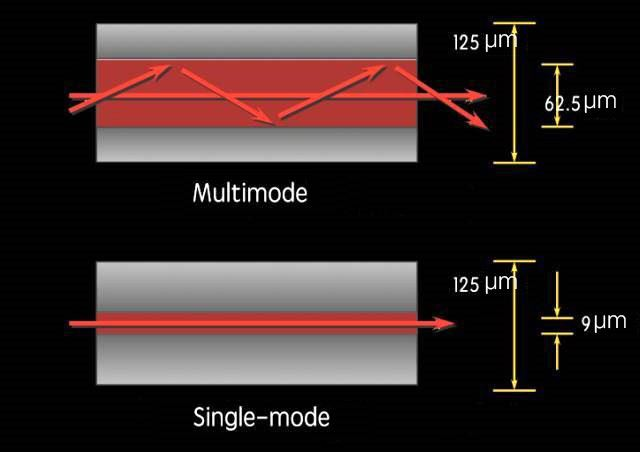
The essential difference between a single mode laser and a multimode laser is that there is one and only one mode in the output beam of a single-mode laser, while there are multiple modes in the output beam mode of a multimode laser. Thus, we can judge whether the laser is single mode or multimode by M2 (beam quality). Lasers are classified into 3 types based on differences in M2. Pure single-mode lasers have an M2 value of less than 1.3. Quasi-single-mode lasers fall between 1.3 and 2.0 in M2. Multimode lasers, meanwhile, feature an M2 greater than 2.0. The key difference lies in output beam modes—single-mode lasers emit only one mode, while multimode lasers produce multiple modes. Thus, we can judge whether the laser is single mode or multimode by M2 (beam quality). According to the difference of M2, laser can be divided into 3 types. Laser with M2<1.3 is pure single mode laser, M2 between 1.3 and 2.0 is quasi single mode laser, while M2>2.0 is regarded as multimode laser.


Difference
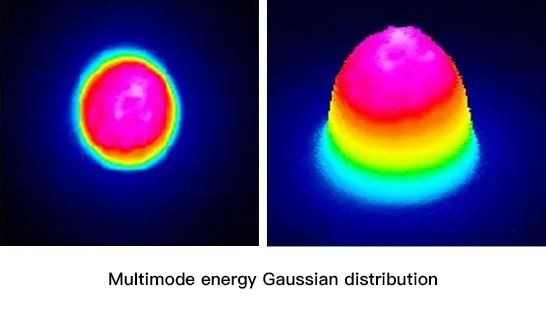
The different modes will directly affect the spatial distribution of energy. From the perspective of energy distribution, single-mode lasers exhibit a typical Gaussian distribution with relatively concentrated energy. In contrast, multimode lasers feature a flat-top distribution where energy is more uniform—composed of multiple superimposed modes, their beam quality is inferior to that of single-mode lasers. When the same laser power is focused via the same optical system, the focal-point energy of single-mode lasers is significantly higher than that of multimode lasers. By comparing their beam quality, focus (or defocus) diameter of spot, divergence, and focus (or defocus) power density, it can be seen that single-mode lasers are better than multimode lasers among these specifications. What’s more, due to the existence of higher-order modes within multimode lasers, compared to single-mode lasers, the multimode laser has greater dispersion and more loss of energy. So multimode lasers are not a good choice for long-distance transmission.


Advantages & Disadvantage
However, a single-mode laser is not superior to a multimode laser in some aspects. The fiber core of a traditional single-mode laser is very thin, and its diameter is very small (generally less than 10 μm). The damage threshold of optical fiber is very low, so it is difficult to bear a large energy light wave. The fiber laser needs the signal laser and pump light to transmit in the core at the same time, so the output power of the fiber laser is very low, and the end area of the fiber is small, so it is difficult to carry out the pump light coupling, which makes the optical-to-optical conversion efficiency of the fiber laser very low. Because the fiber core of a single-mode laser is thin, the nonlinear effect of a single-mode laser is large. A multimode laser increases the diameter of the fiber core on the basis of a single-mode laser, so that there are multiple modes in the fiber and support multiple-mode transmission at the same time. After the coherent superposition of multiple mode fields in a multimode laser, the mode field distribution in the whole fiber core is relatively flat, which can reduce the self-focusing effect in the process of optical transmission. The transmission distance of high-power signal light in the fiber can be relatively long and with high stability. Multimode laser not only improves the damage threshold, but also reduces the laser power density by increasing the cross-sectional area of the fiber, so as to effectively suppress the nonlinear effect in the fiber.

BU-Laser offers high-stability, high-performance single-mode fiber-coupled lasers—specifically engineered for fluorescence imaging, flow cytometry, confocal microscopy, Raman microscopy, DNA sequencing/analysis, medical imaging/instrumentation, genomics, and other related applications. Additionally, we provide premium multi-mode fiber-coupled lasers, widely utilized in LDI exposure machines, laser welding, material processing, 3D printers, and other industrial scenarios.We welcome your ideas and questions! Come and https://www.bu-lasers.com/contact-us/ contact us at song@s-laser.com!


Add comment