120W blue laser technology offers an alternative approach to targeted weed control, especially for agricultural equipment developers exploring automated, non-chemical solutions. However, selecting a laser for field applications requires more than checking its rated optical power. You also need to evaluate wavelength, beam characteristics, thermal management, electrical compatibility, and integration requirements.
The BU-LASER 450nm 120W blue laser module combines a 36V PWM driver with water cooling for integration into laser weeding robots and other industrial equipment. Manufactured by Dongguan Blueuniverse Laser Co., Ltd., this module also supports laser engraving, laser cutting, and compatible 3D printing applications. Understanding its specifications and operating requirements can help you determine whether it fits your equipment design.
Key Features of the 120W Blue Laser Module
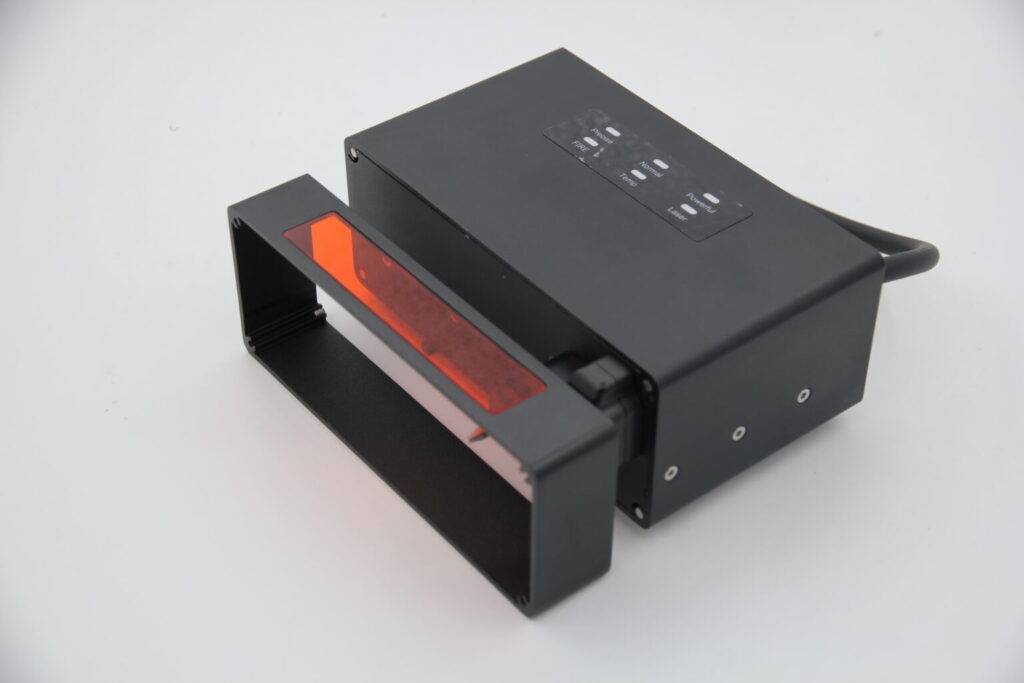
The LY45B120W-TTGJ-T01-1 is designed for applications that require a high-power blue diode laser module and active thermal management.
Key specifications include:
- Wavelength: 435nm / 450nm
- Optical output power: Greater than 110W; the product is marketed as a 120W module
- Working voltage: 36V
- Beam size: Less than 260μm at a 50mm distance, according to the supplied specifications
- Cooling system: Water cooling
- Housing dimensions: 151.5 × 165 × 72.8mm, customizable
- Lens: Optical glass
- Listed service life: More than 10,000 hours
These specifications provide a starting point for system integration. Before purchasing, confirm the exact wavelength configuration, guaranteed output power, beam measurement conditions, and operating limits with BU-LASER.
Why Choose a 450nm Blue Laser for Laser Weeding?
Targeted weed control
Plant pigments absorb light differently across wavelengths. A 450nm blue laser can interact with plant tissue through optical absorption and localized heating, making it a potential energy source for precision weed-control systems.
When you integrate the module into an agricultural robot, the control system must coordinate laser output, weed detection, exposure duration, and movement speed. Actual weed-control performance depends on plant species, growth stage, spot size, exposure conditions, and the distance between the optics and target.
Potential application scenarios include:
- Autonomous agricultural weeding robots
- Greenhouse weed-control equipment
- Machine-vision-guided weed treatment systems
- Research and development platforms for precision agriculture
Unlike conventional herbicide application, laser treatment does not require spraying chemicals onto the target. Nevertheless, you should validate crop safety, treatment effectiveness, energy consumption, and environmental compliance under real operating conditions.
High-power output with PWM control
The module incorporates a 36V PWM driver and is advertised with adjustable output from 0 to 120W. This configuration may help equipment developers coordinate laser output with detection results and treatment requirements.
For example, a robotic platform could use lower power settings for preliminary testing and adjust its operating parameters after evaluating weed response. You should confirm the supported PWM frequency, control interface, response time, and output-power accuracy before finalizing your controller design.
Water Cooling and System Integration
High-power laser diodes generate heat during continuous operation. Effective cooling helps manage component temperatures and maintain consistent operating conditions.
The water-cooled design of this 120W blue laser module makes coolant circulation an important part of the equipment design. You should assess the required flow rate, inlet water temperature, pressure limits, coolant compatibility, and heat-rejection capacity with the manufacturer.
For outdoor agricultural equipment, also consider dust protection, vibration, moisture exposure, and the stability of electrical connections. The module’s listed service life exceeds 10,000 hours, but actual service life depends on operating conditions, cooling performance, and maintenance.
120W Blue Laser vs. Lower-Power Laser Modules
The appropriate laser depends on your application, working distance, treatment requirements, and available cooling capacity.
| Selection factor | 120W blue laser module | Lower-power laser module |
|---|---|---|
| Optical output | Advertised as 120W; specified output exceeds 110W | Depends on the selected model |
| Thermal management | Water cooling | Depends on design and power |
| Electrical integration | 36V working voltage with PWM control | Varies by model |
| Potential applications | High-power weeding and compatible industrial equipment | Lower-power engraving, sensing, or positioning tasks |
| Integration considerations | Greater attention to cooling and laser safety | Depends on output and intended use |
Higher optical power does not automatically guarantee faster treatment or better results. Compare measured performance under equivalent operating conditions before choosing a module for production equipment.
How to Select and Integrate a 120W Blue Laser
Follow these steps when evaluating the module for your project:
- Define your application. Specify whether you need laser weeding, engraving, cutting, or another process, and document the target material or plant conditions.
- Confirm optical requirements. Verify wavelength, output power, beam size, working distance, and required optical configuration.
- Check electrical compatibility. Ensure your power supply supports the 36V input and confirm the PWM interface and control specifications.
- Design the cooling system. Obtain the manufacturer’s coolant flow, temperature, and pressure requirements before building the thermal-management circuit.
- Test the complete system. Evaluate output stability, treatment results, temperature, power consumption, and performance under representative operating conditions.
- Implement laser safety measures. Establish suitable enclosures, interlocks, beam stops, protective equipment, and operating procedures based on the laser’s verified classification and applicable regulations.
Why Work with BU-LASER?
Dongguan Blueuniverse Laser Co., Ltd. has operated since 2010 and develops semiconductor laser diodes, laser modules, and fiber-coupled laser products. Its product portfolio covers wavelengths from 375nm to 980nm, supporting applications such as machine vision, 3D scanning, security, industrial processing, and medical aesthetics.
BU-LASER reports more than 80 patents, including 14 invention patents, and implements the ISO 9001:2015 quality management system. The company also identifies TUV, BV, and SGS among its certification and quality credentials. For your project, request the applicable certificates and confirm their scope and validity.
The company offers OEM and ODM services, allowing you to discuss housing dimensions, optical configurations, and integration requirements for compatible laser applications.
FAQ
1. Is the 120W blue laser module suitable for agricultural laser weeding?
It is designed with laser weeding in mind. Actual suitability depends on weed species, optical setup, exposure conditions, robot speed, and field testing.
2. What cooling system does the 450nm 120W blue laser use?
The module uses water cooling. Confirm coolant flow, inlet temperature, pressure limits, and heat-dissipation requirements with BU-LASER before installation.
3. Can BU-LASER customize the module for OEM projects?
BU-LASER offers OEM and ODM laser-module services. Contact the company to discuss customization options, technical requirements, production feasibility, and order quantities.
Conclusion
The 120W blue laser module from BU-LASER combines a 435nm/450nm wavelength configuration, a 36V PWM driver, and water cooling for demanding industrial integration projects. If you are developing agricultural robots, laser weeding equipment, or compatible laser-processing systems, verify the optical, electrical, and thermal specifications before selecting the module. Careful validation will help you assess whether it meets your performance, safety, and operating requirements.
CTA: Discuss Your Laser Module Requirements with BU-LASER
Contact Dongguan Blueuniverse Laser Co., Ltd. to request the LY45B120W-TTGJ-T01-1 datasheet, confirm technical specifications, and explore OEM/ODM customization for your application.


Add comment