Laser Weeding
Laser weeding is an innovative, chemical-free approach to agricultural weed control that uses high-energy light beams to destroy unwanted plants. Users currently employ several laser types in this application—each offers distinct advantages based on specific weeding scenarios.
Laser weeding systems primarily use carbon dioxide (CO₂), diode, and fiber lasers. Users choose the specific laser type by considering factors like efficiency, portability, and wavelength interaction with plant tissue.
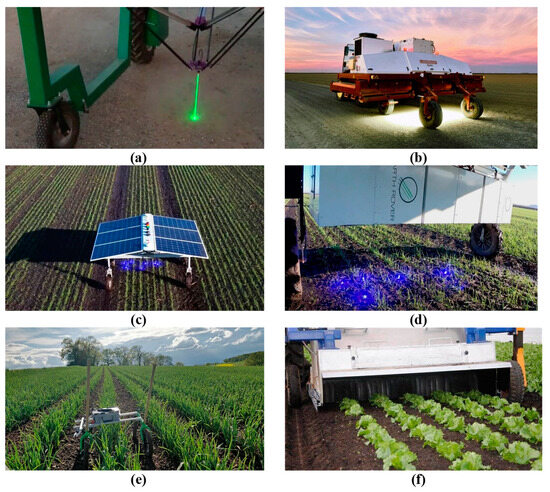
Types of Lasers Used for Weeding
CO₂ Lasers:
These are the most common type used in early commercial systems, such as those by Carbon Robotics. They operate in the far-infrared spectrum (around 10,600 nm). By heating the high water content in plant cells, they create thermal damage—essentially, this process boils the plant tissue to eliminate weeds.
- Pros: Highly effective at damaging the plant surface.
- Cons: Low energy efficiency, large size, heavy, and require water cooling systems, making the overall machine bulky and increasing fire risk in dry conditions. The infrared beam is absorbed by water droplets on leaves, which can reduce efficacy in wet conditions.
Diode Lasers and Blue Lasers:
Diode lasers typically operate in the near-infrared (around 940 nm or 980 nm) or visible blue light spectrum (around 450 nm). Blue lasers are gaining prominence as a state-of-the-art solution.
- Pros: More compact, lightweight, highly energy-efficient, and run on lower voltage, which increases safety in the field. Blue light is strongly absorbed by chlorophyll and transmits very well through water. As a result, it works highly effectively even on wet leaves or in flooded fields.
- Cons: In some specific scenarios, they may consume more energy per weed than CO₂ lasers. However, their overall system efficiency is higher.
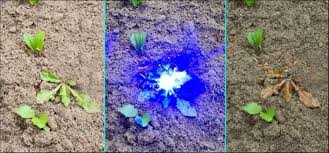
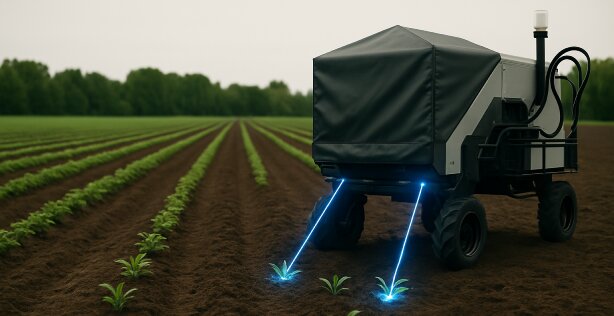
Dongguan Blueuniverse Laser Co., Ltd manufactured blue diode lasers from 1W to 500W, we also can offer professional OEM&ODM service for weeding control lasers.
Fiber Lasers:
These are solid-state lasers with a doped glass fiber as the active medium. Additionally, they typically emit in the visible to near-infrared spectrum. Notably, thulium-doped fiber lasers (around 2 µm) are particularly effective—their radiation penetrates deeper into plant tissue to heat internal water, not just the surface.
- Pros: Offer very high beam quality and are robust for field use with minimal maintenance.
- Cons: Can be more expensive than CO₂ systems on a price-per-watt basis.
In essence, while users employ different laser types, robotic weeding systems are trending towards more compact, energy-efficient blue diode and fiber lasers—thanks to their pragmatic benefits in field environments.
BU-LASER provides Diode laser modules with multiple specification choices(output power, beam divergence, beam size, working distance, and dimension) better meet customers’ needs of accurate laser positioning/locating/orientating. To know more, please contact us at song@bu-laser.com.

2 comments
Thomasdyelm
Excuse, I have thought and have removed the idea
_ _ _ _ _ _ _ _
car hire granada
EugeneSoari
Now all is clear, I thank for the help in this question.
_ _ _ _ _ _ _ _
https://automietenmallorca.de