
When standard laser sources cannot deliver stable energy transmission, precise beam control, or flexible integration, choosing the right fiber coupled laser becomes critical. Many engineers need a compact laser solution that supports demanding applications such as LDI exposure, UV curing, photolithography, and 3D printing while maintaining consistent optical performance.
A professional fiber coupled laser module combines semiconductor laser technology with fiber delivery to provide reliable beam transmission, high coupling efficiency, and flexible system integration. BU-LASER develops customized laser solutions from 375nm to 980nm, including the 405nm 5W space coupling fiber laser module designed for industrial precision applications.
What Is a Fiber Coupled Laser Module?
A fiber coupled laser module is an optical device that combines laser diode output with coupling optics and transfers the laser energy into an optical fiber. This structure allows engineers to place the laser source away from the working area while delivering controlled optical power through the fiber.
BU-LASER’s 105um Violet 405nm 5W Space Coupling Fiber Laser Module uses advanced optical coupling technology to achieve stable energy transmission for precision manufacturing.
Key specifications include:
- Wavelength: 405nm ±5nm
- Output Power: 4-5.2W CW
- Fiber Core Diameter: 105μm
- Working Voltage: 16.5-18V
- Housing Size: 53.8 × 25 × 16mm (customizable)
- Fiber Interface: FC connector / SMA905
- Lifetime: 10,000 hours
These specifications make the module suitable for applications requiring high-energy near-UV exposure and accurate optical delivery.
Why Choose BU-LASER 405nm Fiber Coupled Laser?
Choosing the correct laser supplier affects system stability, production efficiency, and long-term maintenance costs. BU-LASER provides professional laser development based on more than 15 years of industry experience.
1. Precise 405nm UV Laser Performance
The 405nm wavelength provides high photon energy suitable for UV-sensitive materials.
The module supports:
- Photoresist exposure in PCB manufacturing
- UV curing processes
- SLA and DLP 3D printing
- Lithography equipment
- Solder mask curing
The near-UV wavelength improves material absorption while reducing unnecessary thermal impact during precision processing.
2. Flexible Fiber Coupling Design
Compared with traditional direct-output laser sources, a fiber coupled laser module offers easier mechanical integration.
Advantages include:
- Flexible beam delivery through optical fiber
- Compact installation structure
- Stable optical output
- Customizable fiber interface options
- Support for OEM and ODM designs
BU-LASER provides customized laser modules covering wavelengths from 375nm to 980nm to meet different industrial requirements.
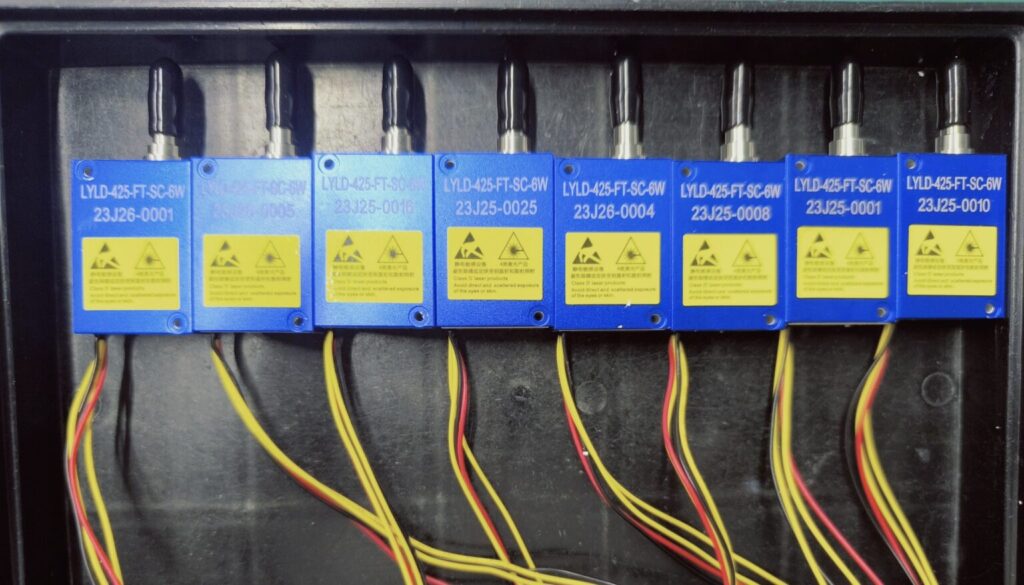
Fiber Coupled Laser vs Traditional Laser Module
| Feature | Fiber Coupled Laser Module | Traditional Laser Module |
|---|---|---|
| Beam delivery | Flexible fiber transmission | Fixed optical output |
| Installation | Easier system integration | Requires more space |
| Application range | LDI, 3D printing, photolithography | General positioning and indication |
| Customization | Wavelength, power, housing available | Limited options |
| Industrial use | Precision processing systems | Basic laser applications |
For manufacturers developing advanced optical equipment, a fiber coupled solution provides better flexibility and system design possibilities.
How to Select a Fiber Coupled Laser Module for Your Application
Before purchasing a laser module, you should evaluate several technical factors:
- Define the required wavelength Select the wavelength according to material absorption characteristics. For UV curing and photolithography, 405nm is commonly used.
- Confirm optical power requirements Check whether the application requires continuous-wave output, peak power, or specific energy density.
- Evaluate fiber specifications Consider fiber core diameter, connector type, and transmission distance.
- Check customization capability A reliable manufacturer should support housing modifications, optical adjustments, and OEM production.
- Verify quality certifications Review supplier qualifications, testing standards, and production capability before cooperation.
BU-LASER Manufacturing Experience and Certifications
BU-LASER, operated by Dongguan Blueuniverse Laser integrates research, production, and sales of semiconductor lasers and optical solutions.
The company provides:
- Over 15 years of laser R&D experience
- More than 80 patents, including 14 invention patents
- ISO9001:2015 quality management system certification
- TUV, BV, and SGS certifications
- OEM and ODM services for industrial laser applications
Since 2010, BU-LASER has supplied laser solutions for industries including laser security, 3D scanning, medical beauty, AR interaction, barcode scanning, machine vision, and optical display.
FAQ
1. What applications use a 405nm fiber coupled laser?
A 405nm fiber coupled laser is commonly used in LDI exposure, UV curing, PCB photolithography, SLA/DLP 3D printing, and precision material processing.
2. Can BU-LASER customize fiber coupled laser modules?
Yes. BU-LASER provides OEM and ODM services, including customized wavelength, output power, housing dimensions, and fiber interface options.
3. What is the lifetime of the 405nm 5W fiber coupled laser module?
The standard 405nm 5W space coupling fiber laser module offers a lifetime of approximately 10,000 hours under proper operating conditions.
Conclusion
Selecting the right fiber coupled laser helps you achieve stable optical transmission, accurate processing results, and easier equipment integration. With a 405nm wavelength, 5W output power, compact structure, and flexible customization options, BU-LASER’s fiber coupled laser modules support demanding applications such as LDI exposure, UV curing, and UV 3D printing.
With over 15 years of laser manufacturing experience, certified quality systems, and OEM/ODM capabilities, Dongguan Blueuniverse Laser provides reliable laser solutions for global industrial customers.
Contact BU-LASER today to discuss your customized fiber coupled laser module requirements and receive professional technical support.
Add comment