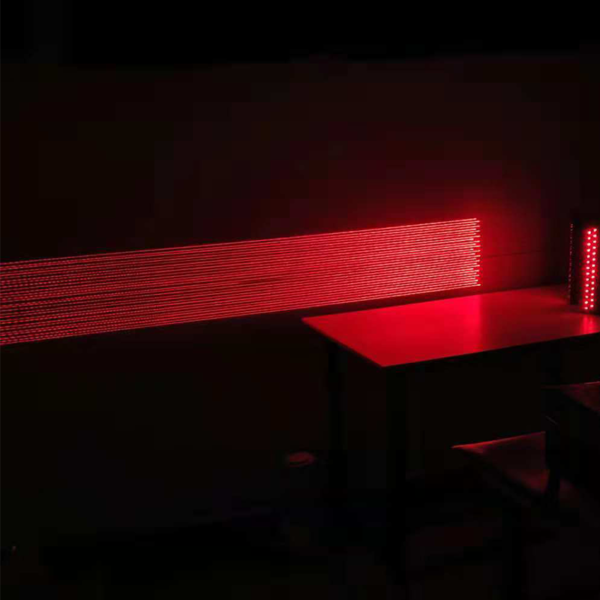
640nm red line laser modules have become critical tools for modern design engineers. Today, technical teams must deliver increasingly sophisticated components under tight schedules. However, many complex designs introduce tough tracking and alignment difficulties. Conventional orientation methods frequently struggle to handle these tasks with sufficient optical clarity. For instance, traditional LED light bars often fail when subjected to high-ambient factory glare. Standard 650nm pointer diodes also struggle on complex surface textures or long-distance scanning paths. Consequently, these substandard light sources cause compromised data capture and severe system calibration errors.
Fortunately, utilizing a professional-grade 640nm red line laser offers a practical alternative for global engineering teams. Instead of modifying heavy industrial layouts to accommodate low-visibility lighting, engineers can maintain their exact performance objectives. They can leverage advanced semiconductor diode alignment to manage geometric positioning seamlessly. Therefore, Dongguan Blueuniverse Laser Co., Ltd. (BU-LASER) has developed a premium product line to solve these specific floor issues. These optoelectronic technologies transform raw digital designs into fully certified, deployment-ready industrial high-visibility industrial positioning lasers. These systems are characterized by uniform power distribution and consistent structural integrity. Furthermore, our agile manufacturing methodology shortens system integration cycles for equipment manufacturers worldwide. This approach applies to both our precision fiber-coupled laser modules for LDI exposure and our low-volume production runs. As a result, it reduces material waste and eliminates upfront tooling costs.
The Core Technical Barriers of Industrial Laser Alignment
Transitioning from lab-scale optical testing to real-world industrial environments exposes optical assemblies to demanding physical stresses. Therefore, engineering teams routinely encounter specific operational limits when deploying sub-standard laser modules.
- Wavelength Drift: Cheap laser diodes experience massive color and intensity shifts as internal temperatures rise. Consequently, the projected beam fades rapidly against bright backgrounds.
- Line Thickness Blur: Standard acrylic lenses expand and warp under continuous thermal exposure. Thus, they twist a sharp positioning line into a wide, blurry oval over long distances.
- Voltage Incompatibility: Industrial automation platforms run on diverse electrical frameworks, such as 12V or 24V inputs. Therefore, fragile laser components fail immediately without robust internal voltage regulation.
Understanding these field limitations clarifies why upgrading is critical to securing repeatable long-term performance. Specifically, engineers should select a precision-stabilized adjustable line laser module for machine vision.
Technical Specifications of the 640nm Red Line Laser
Not all optoelectronic contract vendors possess the necessary manufacturing precision. Sourcing a dependable module demands an objective evaluation of exact technical boundaries. Therefore, BU-LASER fulfills these high expectations through our standard 640nm product matrix:
| Technical Benchmark Component | Standard Product Specifications | Advanced Engineering Options |
| Central Operating Wavelength | 640nm $\pm$ 5nm (Vibrant Red) | Custom adjustments from 375nm to 1064nm |
| Optical Output Power Range | 5mW to 2.5W (Single Diode Option) | Scalable multi-diode systems up to 100W |
| Beam Profile Configuration | Uniform Linear Projection | Cross, grid, multi-line, or custom DOE profiles |
| Fan Angle Characteristics | 90° / 110° Standard Fan Angles | 5° / 15° / 30° / 45° / 130° / 180° variations |
| Line Geometry Performance | Focused width $\le$ 2mm at 5 meters | Precision spatial optical-fiber coupling setups |
| Lens Assembly Material | Premium Anti-Reflective Glass Lens | Acrylic, wave, or specialized Powell lenses |
| Input Operating Voltage | 3V / 5V / 12V DC Configurations | 24V / 30V / 220V alternative industrial inputs |
| Certified Component Lifespan | $\ge$ 10,000 Hours (Continuous Run) | Supported by TUV, BV, and SGS certifications |
Optical Architecture of the 640nm Red Line Laser
Achieving extreme linear precision requires a granular understanding of laser beam physics. Selecting a BU-LASER module ensures that key physical components work in perfect harmony. Consequently, the system maintains excellent structural stability during continuous operational duty.
Premium Powell and Wave Glass Optics
Conventional line generators create a Gaussian distribution. In these basic setups, the laser energy peaks in the center and fades rapidly at the outer edges. To eliminate this issue, BU-LASER integrates premium optical glass Powell lenses. These components distribute the laser energy evenly across the entire length of the projected line. Therefore, this mechanism ensures a uniform, crisp line width from edge to edge. In addition, it maximizes reading accuracy for automated machine vision sensors.
Robust Thermal Housing Design
Optical consistency depends heavily on efficient heat dissipation. For this reason, our high-power 640nm red line laser modules are encased in rugged, compact metal housings. Our standard sizes include 921mm and 1666mm configurations alongside customizable shapes. These enclosures are designed to maximize thermal conductivity. Thus, they keep the laser diode operating within its optimal temperature window. Furthermore, this protective design effectively prevents premature power degradation over time.
Multi-Industry Application Workflows
Advanced custom semiconductor laser solutions for automation operate as core technological enablers. Today, these systems support a broad spectrum of high-tech modern engineering fields.
- Machine Vision: The module serves as a high-contrast structured light source for non-contact testing. Furthermore, it excels in surface profiling and automated facial recognition setups.
- Smart Infrastructure: These units integrate smoothly into crossroad warning lights and camera focusing systems. Consequently, they establish active visual safety boundaries that perform flawlessly in low-light environments.
- LDI Exposure: Our teams utilize specialized high-power fiber-coupled modules to drive precision LDI PCB exposure systems. Therefore, this technology reduces reliance on costly imported components.
- Medical Aesthetics: These lasers are deployed as highly accurate indication pointers for medical imaging equipment. In addition, they serve as reliable alignment guides for surgical machinery layout.
Why Choose BU-LASER as Your Optoelectronic Partner
Selecting an experienced, vertically integrated manufacturer is essential for your business. This choice is critical when securing long-term contract supply chains that mandate absolute compliance.
15+ Years of Proven Innovation
BU-LASER was founded in 2010. Since then, the company has grown into a leading semiconductor laser enterprise. We are backed by over 80 domestic and international technology patents. Furthermore, our portfolio includes 14 core invention patents. Therefore, our engineering team possesses the deep technical expertise required to solve complex spatial optical-fiber coupling challenges.
Certified Manufacturing and Global Compliance
We enforce rigid quality inspection controls across every stage of our production process. Our facilities operate in strict accordance with the ISO9001:2015 quality management system standard. In addition, our product catalog carries full TUV, BV, and SGS compliance certifications. This technical oversight guarantees seamless alignment with international safety classifications. Thus, it ensures safe global export for your orders.
Scalable OEM/ODM Production Capacity
We recognize that every automated line or medical device enclosure requires a unique form factor. Therefore, BU-LASER provides complete, end-to-end OEM and ODM services. Clients can easily adjust operating voltages, scale output power limits, or customize beam profiles. As a result, our factory matches your precise system architecture every time.
Conclusion
Active laser positioning represents the next generation of industrial automation and machine vision tracking. By replacing traditional, low-contrast illumination methods with a precision-engineered 640nm red line laser, development teams can implement smarter environments. These sensory frameworks perform flawlessly in demanding conditions.
Furthermore, partnering with a certified optoelectronic specialist like BU-LASER provides your organization with far more than high-performance hardware. It grants you direct access to patented technology, multi-tiered laboratory verification, and dependable batch-to-batch structural consistency. Therefore, you can launch your products with absolute market confidence. Contact our technical sales headquarters in Dongguan today to request an official engineering quote. In addition, you can download comprehensive product schematics or consult with our specialists to design a customized laser solution.

Add comment