A red laser diode must deliver consistent optical output, fit your optical assembly, and operate within your equipment’s electrical and thermal limits. Choosing a component based only on its wavelength or power rating can lead to integration problems, unstable performance, or unnecessary redesign costs.
The 658nm 60mW continuous-wave (CW), 140mW pulsed red laser diode from BU-LASER features a compact TO-18 package with a 5.6mm diameter. It is designed for applications that require visible red laser emission in a small semiconductor component. Before selecting this diode for your project, you should evaluate its wavelength tolerance, operating conditions, beam divergence, and compatibility with your driver circuit.
Dongguan Blueuniverse Laser Co., Ltd. develops and manufactures semiconductor laser diodes and laser modules for industrial and commercial applications. Understanding the product specifications will help you determine whether this component meets your system requirements.
Key Specifications of the 658nm Red Laser Diode
This semiconductor laser diode combines visible red emission with a compact metal package. Its specifications provide a starting point for optical design and component selection.
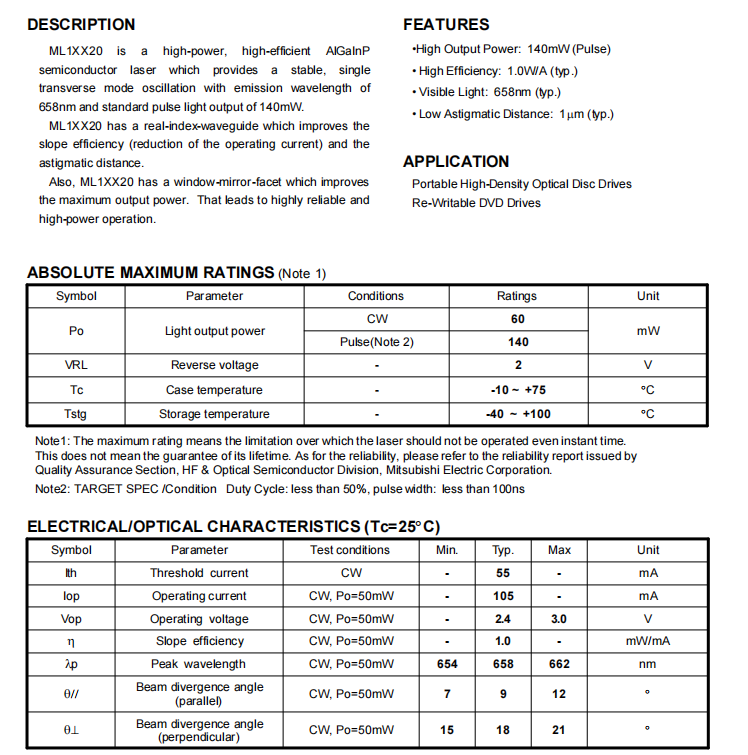
| Parameter | Specification |
|---|---|
| Product type | Red semiconductor laser diode |
| Typical wavelength | 658nm |
| Continuous-wave output | 60mW |
| Pulsed output | 140mW |
| Package | TO-18, 5.6mm diameter |
| Typical operating current | 33mA, according to the supplied summary |
| Typical operating voltage | 2.2V, according to the supplied summary |
| Parallel beam divergence | 9° (1/e²) |
| Perpendicular beam divergence | 18° (1/e²) |
| Operating temperature | -10°C to +70°C |
| Storage temperature | -40°C to +100°C |
| Product SKU | ML101J20 |
The supplied detailed description lists different operating current and voltage values, as well as a case-temperature range extending to +75°C. It also refers to both 650nm and 658nm. Confirm the applicable datasheet and revision with BU-LASER before finalizing your circuit or production specification.
Continuous-Wave vs. Pulsed Output
Continuous-wave operation provides sustained laser output, while pulsed operation delivers energy in timed bursts. This diode is listed with a maximum CW output of 60mW and a pulsed output of 140mW.
The two ratings are not interchangeable. Pulsed operation depends on conditions such as pulse width, duty cycle, drive current, and thermal management. Confirm the manufacturer’s limits before designing a pulse driver or estimating the optical energy delivered during each pulse.
What Does the TO-18 5.6mm Package Mean?
The TO-18 package provides a compact metal housing for mounting a semiconductor laser diode. Its nominal 5.6mm diameter helps engineers evaluate mechanical fit when designing optical assemblies, mounting fixtures, and replacement components.
However, package diameter alone does not guarantee compatibility. You should also check pin configuration, mounting orientation, optical-axis alignment, heat dissipation, and the required mechanical tolerances.
When comparing a 5.6mm red laser diode with another component, verify that both parts share the necessary electrical and mechanical interfaces.
Where Can You Use a 658nm Red Laser Diode?
Visible red laser diodes can support applications that need a compact, directional light source. The suitability of this particular component depends on the required optical power, beam characteristics, operating environment, and applicable safety requirements.
Potential application areas include:
- Positioning and alignment: Providing a visible reference point in equipment where red light assists setup or component alignment.
- Optical sensing: Serving as a light source in sensor designs that can use the diode’s wavelength and output characteristics.
- Barcode and optical equipment: Supporting designs that require a visible red semiconductor light source, subject to optical-system compatibility.
- OEM instrumentation: Integrating into custom equipment where the TO-18 package meets the available space and mounting requirements.
For scanning, measurement, or other precision applications, evaluate the complete optical system rather than assuming that the diode alone determines accuracy.
How to Select the Right Red Laser Diode
Follow these steps before placing a production order.
- Define the wavelength requirement. Confirm whether your system requires 658nm specifically or accepts a wider wavelength range. Request the manufacturer’s tolerance and test conditions.
- Choose the output mode. Determine whether your application needs continuous output or pulsed operation. Establish the required power, pulse width, and duty cycle.
- Check electrical compatibility. Compare the verified forward voltage and operating current with your driver circuit. Include current regulation and protection in your design.
- Evaluate beam characteristics. Review the 9° parallel and 18° perpendicular divergence specifications. Determine whether your design needs additional collimating or focusing optics.
- Verify packaging and thermal limits. Check the TO-18 mounting dimensions, pinout, heat dissipation, and allowable case temperature.
- Confirm production requirements. Ask about sample availability, datasheet revisions, traceability, expected quantities, and OEM/ODM options before committing to volume production.
Red Laser Diode vs. Laser Module
A bare laser diode and a laser module serve different integration needs. A diode is a semiconductor light-emitting component, whereas a module may include additional optics, a housing, a driver, or other components depending on its design.
| Comparison | Red Laser Diode | Red Laser Module |
|---|---|---|
| Main function | Generates laser light | Integrates a light source into an assembly |
| Integration | Requires component-level design | Depends on included electronics and optics |
| Optical configuration | Determined by the diode and external optics | May include collimation or focusing optics |
| Typical buyer | Component engineers and OEM manufacturers | Equipment designers seeking an integrated assembly |
If your design already includes a driver and optical alignment system, a bare diode may be appropriate. If you need a more integrated solution, compare the available laser modules against your mechanical and optical requirements.
Why Consider BU-LASER as Your Supplier?
Dongguan Blueuniverse Laser Co., Ltd. has operated since 2010, combining laser research and development, production, and sales. Its product range covers semiconductor laser diodes, laser modules, and fiber-coupled lasers across multiple wavelengths.
According to the company’s supplied information, BU-LASER holds more than 80 patents, including 14 invention patents, and operates under an ISO 9001:2015 quality management system. The company also reports TUV, BV, and SGS-related certifications or inspection credentials; confirm the specific certificate scope and validity relevant to your purchase.
BU-LASER offers OEM/ODM services for customers developing application-specific optical equipment. When evaluating a supplier, request the product datasheet, applicable inspection records, sample test results, and production specifications that match your project.
Frequently Asked Questions
1. Is this a 650nm or 658nm red laser diode?
The product title and initial specification identify 658nm as the typical wavelength. Other supplied text refers to 650nm, so confirm the exact model specification with the manufacturer before ordering.
2. Can the diode provide 140mW continuously?
The listed continuous-wave rating is 60mW, while 140mW is specified for pulsed operation. Do not treat the pulsed rating as a continuous output rating.
3. Is a TO-18 5.6mm diode compatible with every 5.6mm mount?
No. Diameter is only one mechanical parameter. Check the pinout, mounting geometry, optical axis, electrical limits, and thermal requirements before integration.
Conclusion
Selecting the right red laser diode requires more than matching a wavelength and output-power figure. The 658nm, 60mW CW and 140mW pulsed BU-LASER diode offers a TO-18 5.6mm package for compact optical designs, but you should verify its conflicting electrical and wavelength specifications before committing to a design. By confirming the datasheet, drive conditions, beam requirements, and mounting compatibility, you can reduce integration risks and make a better-informed component choice.
Request Technical Information from BU-LASER
Contact Dongguan Blueuniverse Laser Co., Ltd. to request the current datasheet, confirm the ML101J20 specifications, and discuss samples or OEM/ODM requirements for your application.

Add comment