
A green laser bird deterrent system is increasingly used in industries where bird activity creates operational, safety, and hygiene risks. Airports, logistics hubs, farms, and energy facilities often face recurring issues such as contamination, equipment damage, and compliance challenges caused by bird nesting and droppings.
The problem is not occasional bird presence but continuous exposure in large open environments where traditional deterrents fail to provide stable coverage. Nets, spikes, and chemical repellents often require constant maintenance and still leave gaps in protection.
BU-LASER, a high-tech optoelectronic enterprise specializing in semiconductor laser systems from 375nm to 980nm, develops industrial laser bird control solutions designed for continuous outdoor operation. With ISO9001:2015 certification, 80+ patents, and TÜV, SGS, BV compliance, the company focuses on scalable optical systems used in real industrial environments.
This article explains how a green laser bird deterrent works, where it is used, and what decision factors matter before deployment.
What Is a Green Laser Bird Deterrent System?
A green laser bird deterrent system uses a moving 520nm laser beam to influence bird behavior through visual stimulation rather than physical force.
BU-LASER integrates semiconductor laser technology into modular optical systems that generate continuous scanning patterns across open environments.
Core mechanism:
- Moving laser creates perceived threat signals
- Birds react with avoidance behavior
- Continuous motion prevents adaptation
- Area becomes unsuitable for nesting
This makes the system suitable for industrial laser bird control applications where long-term stability is required.
Why Green Laser Bird Deterrent Technology Works
The effectiveness of a green laser bird deterrent system is linked to the 520nm wavelength, which falls within a highly visible range for many bird species.
Key performance factors:
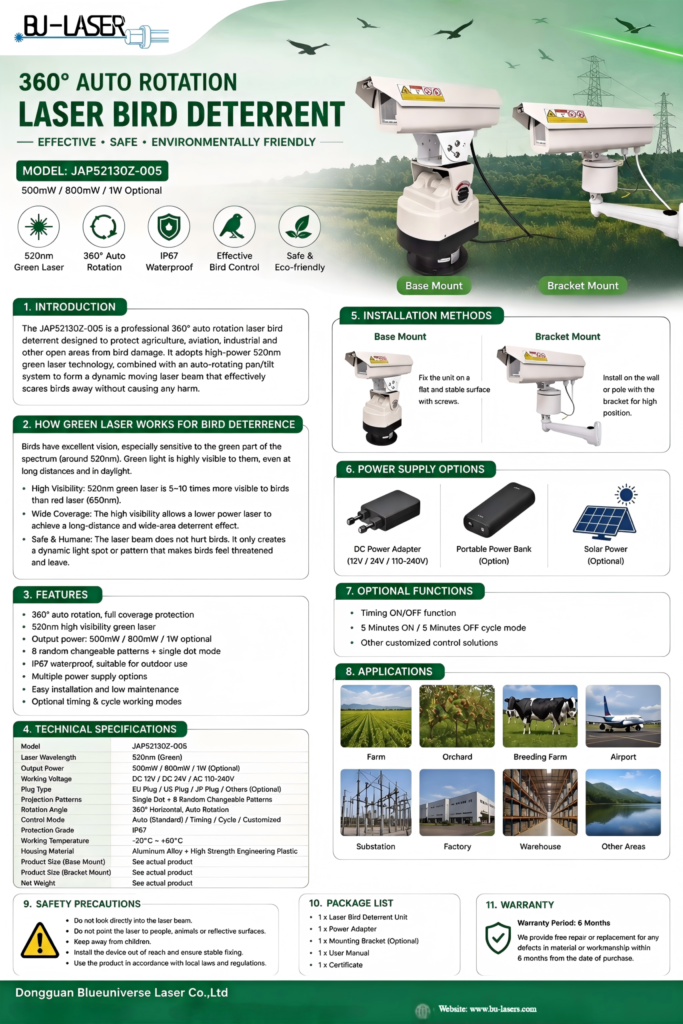
- Strong visibility under daylight conditions
- High detection sensitivity across species
- Effective coverage in open industrial spaces
- Stable response in large-scale environments
BU-LASER applies these optical principles in its laser bird control systems for airports, warehouses, and energy infrastructure, ensuring consistent performance under harsh outdoor conditions.
Green Laser Bird Deterrent vs Traditional Methods
| Method | Limitations | Industrial Suitability |
|---|---|---|
| Bird spikes | Only contact-based protection | Low |
| Netting systems | High installation + maintenance cost | Medium |
| Chemical repellents | Temporary and weather-dependent | Low |
| Sonic devices | Noise pollution + adaptation | Medium |
| Green laser bird deterrent | Requires proper installation | High |
Traditional systems often fail in wide-area environments. In contrast, BU-LASER green laser bird deterrent systems provide automated scanning coverage without physical barriers.
How a Green Laser Bird Deterrent Works
The system operates through continuous optical scanning controlled by internal motorized rotation.
Step-by-step process:
- The system emits a 520nm moving laser beam
- Birds detect motion and interpret risk signals
- Immediate avoidance response occurs
- Continuous scanning prevents habituation
- Area becomes unattractive for return
This mechanism allows BU-LASER systems to operate effectively as 360-degree rotating laser bird deterrent solutions for industrial sites.
Key Features of BU-LASER Systems
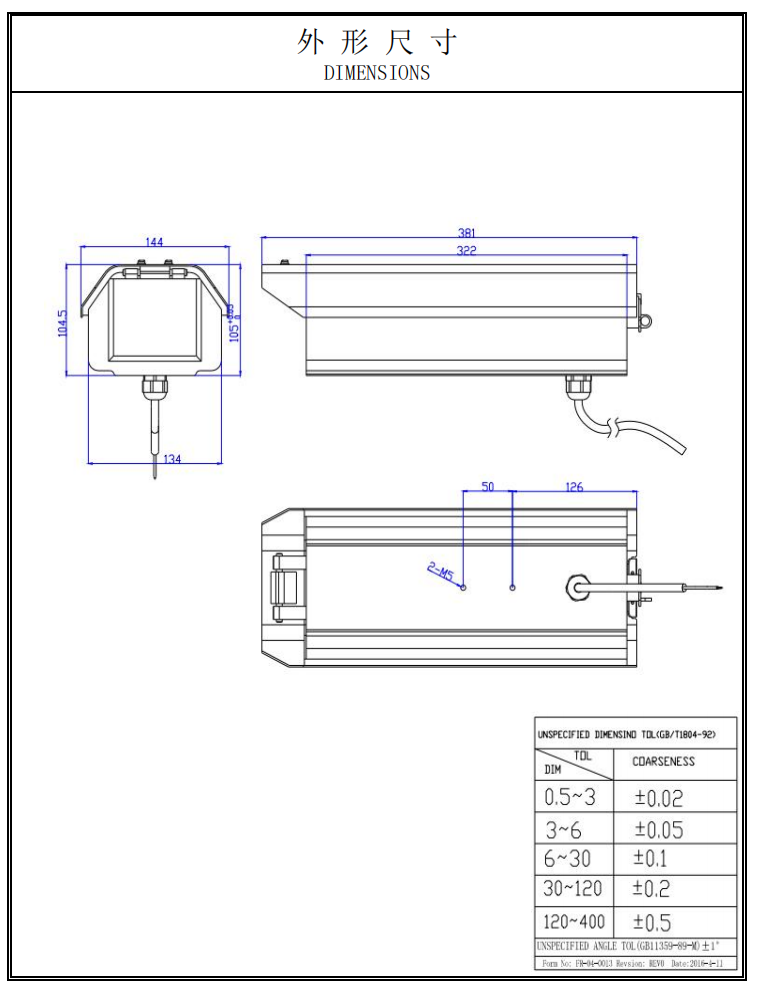
BU-LASER develops optical systems designed for industrial-grade reliability and global deployment.
Technical capabilities:
- 360-degree automatic rotation for full-area scanning
- Stable 520nm output for long-distance visibility
- IP65-rated protection for outdoor environments
- Flexible installation options (wall, pole, ground)
- Humane non-lethal bird deterrent technology
The company operates under ISO9001:2015 quality standards and serves global partners through OEM/ODM production models.
Decision Factors Before Purchase
Selecting a green laser bird deterrent system requires evaluation beyond basic specifications.
Key considerations:
- Coverage area and installation height
- Environmental conditions (wind, rain, dust exposure)
- Required scanning angle and rotation speed
- Maintenance cycle and operational stability
- Site layout complexity
BU-LASER typically supports clients with system customization based on site engineering requirements.
FAQ
1. Does a green laser bird deterrent really work?
Yes. It is effective in open environments where birds rely heavily on visual navigation cues.
2. Is it safe for birds and humans?
Yes. BU-LASER systems are non-lethal and designed for behavioral deterrence without physical harm.
3. Where is it commonly used?
Airports, farms, logistics warehouses, substations, and food processing facilities.
Conclusion
A green laser bird deterrent represents a shift toward automated, scalable, and maintenance-efficient bird control in industrial environments.
BU-LASER combines semiconductor laser engineering, certified manufacturing standards, and OEM/ODM flexibility to deliver laser bird control systems for global industrial applications.
For industries dealing with persistent bird-related operational risks, optical deterrent technology provides a practical balance between efficiency, safety, and long-term cost control.


Add comment